At The Mesh Company, we spend a lot of time bridging the gap between specialist mesh products and real-world requirements. Not everything needs to be an architectural façade or a bespoke specification – but that doesn’t mean customers shouldn’t have access to genuinely high-quality materials.
That’s exactly why we’re pleased to introduce our 316L stainless steel pre-crimped wire mesh with an 80 × 10mm pattern into our e-commerce range.
This is a serious, heavy-duty woven mesh, supplied in practical sizes, available for fast dispatch, and suitable for customers who need strength, rigidity and longevity without stepping into full architectural procurement.
What Is Pre-Crimped Wire Mesh?
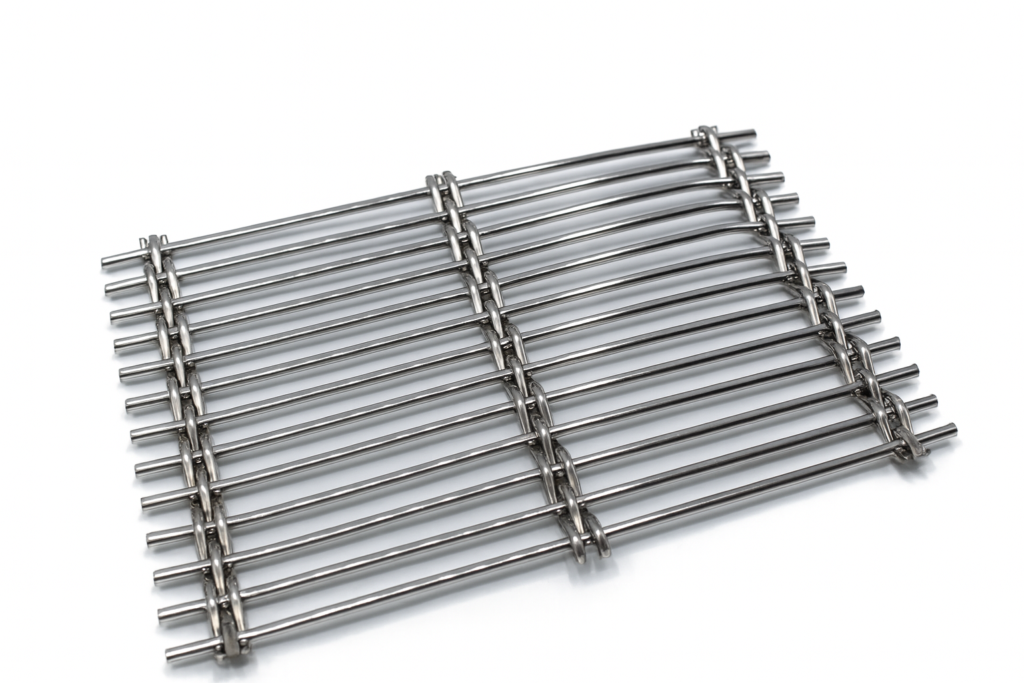
Pre-crimped wire mesh is produced by forming each wire with a crimp before weaving, rather than relying on tension alone to hold the structure together. The result is a mesh that behaves more like a rigid panel than a flexible fabric.
Unlike standard woven mesh, where wires can shift slightly under load, pre-crimped mesh locks into place. Once woven, the structure is stable, strong, and highly resistant to deformation.
In simple terms:
- Standard woven mesh = flexible and adaptable
- Pre-crimped woven mesh = fixed, panel-like, and very strong
That makes this type of mesh particularly well suited to applications where rigidity matters.
Understanding the 80 × 10mm Pattern
The “80 × 10” designation refers to the pitch, not the clear aperture. This is an important distinction and one that often causes confusion.
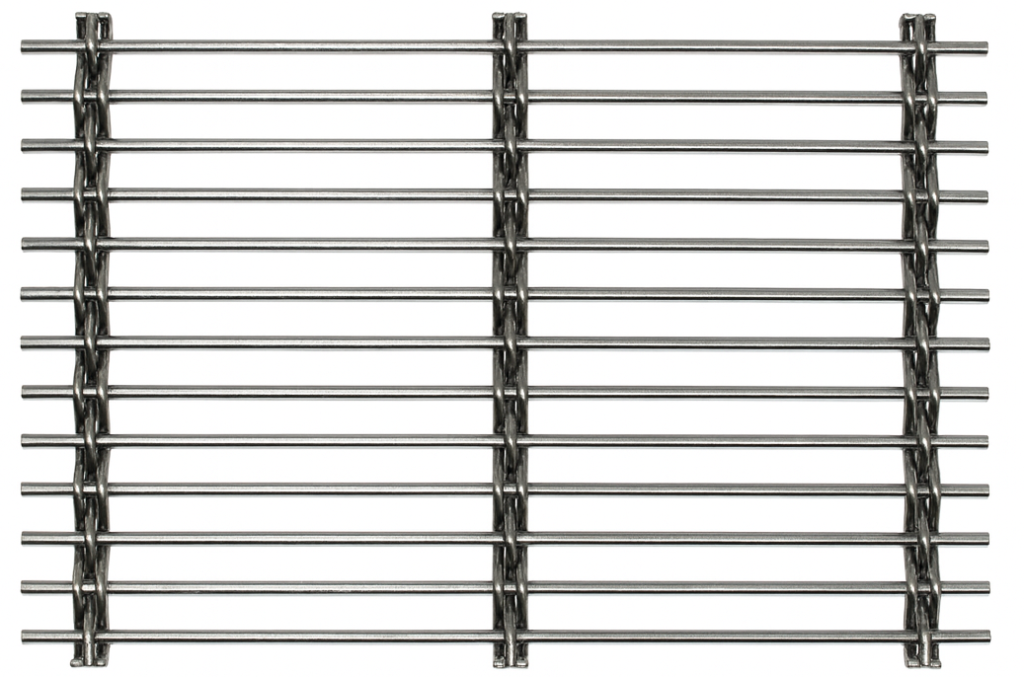
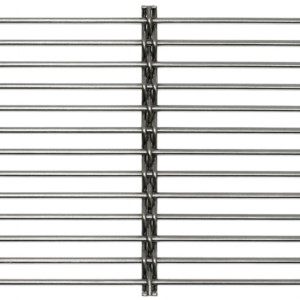
- The 80 mm pitch refers to the spacing of the heavier horizontal elements
- The 10 mm pitch refers to the spacing of the vertical rods
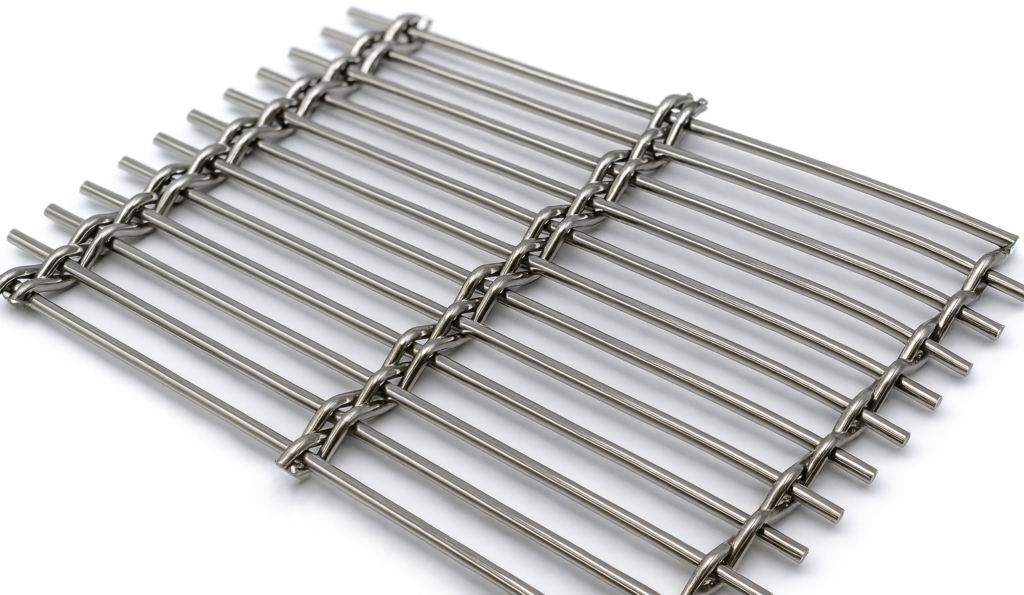
Because this mesh evolved from cable-based architectural systems, it has retained pitch-based naming rather than aperture-based naming. In reality, the clear openings are irregular, but that’s exactly what gives this mesh its distinctive strength and appearance.
Visually and structurally, it behaves much more like a rigid grid or panel than a traditional mesh.
Heavy-Duty Construction – What Makes This Mesh Different?
his is not a lightweight product.
The structure consists of:
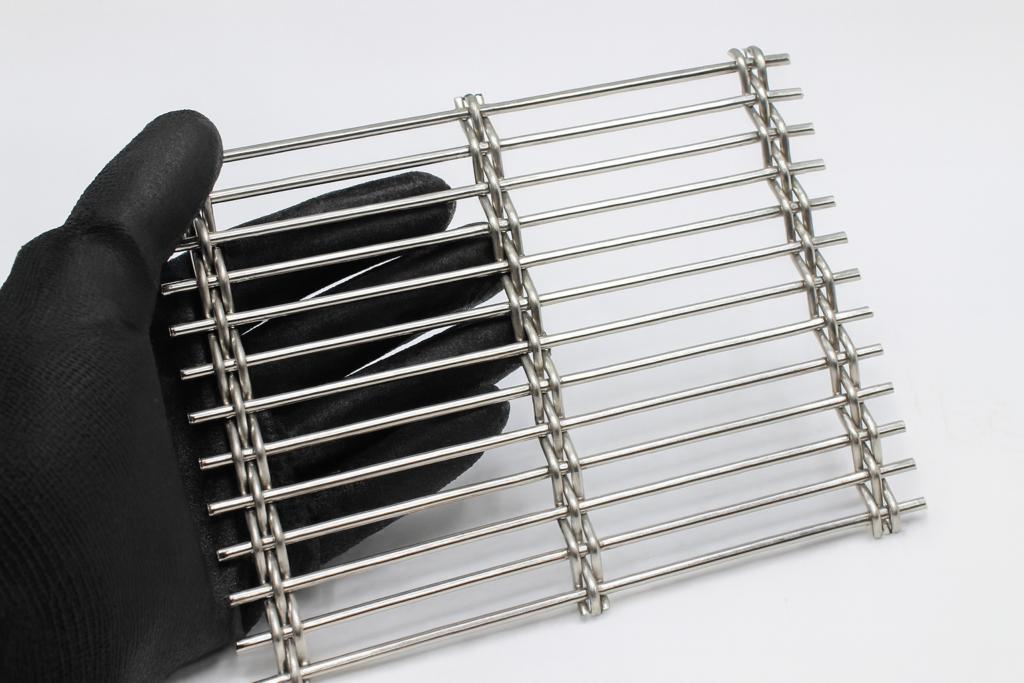
- Three flattened stainless steel wires grouped together running in one direction
- Single solid rods running perpendicular, locking the mesh together
- A substantial wire profile that creates real stiffness
When you pick this mesh up, it immediately feels different. There is very little flex, and it resists distortion far more than welded mesh or standard woven mesh of a similar openness.
This makes it ideal where:
- Impact resistance is required
- The mesh needs to span openings without sagging
- Visual strength and robustness are important
Why 316L Stainless Steel?
We’ve chosen to supply this mesh in 316L stainless steel for a reason.
316L offers:
- Excellent corrosion resistance
- Superior performance in damp, external or coastal environments
- Long service life with minimal maintenance
- A clean, industrial finish that doesn’t degrade over time
For customers who are installing mesh in exposed areas, plant rooms, vents, outdoor enclosures, or anywhere longevity matters, 316L is the right choice.
This is a material that’s designed to last.
What Would E-Commerce Customers Use This Mesh For?
Although this pattern originates from architectural design, there are plenty of practical, real-world uses that make sense for our retail customers.
Common applications include:
Heavy-Duty Vent Covers and Screens
Where airflow is needed but strength cannot be compromised – for example, plant rooms, generator housings, or industrial ventilation openings.
Security and Protective Panels
Ideal for covering openings, creating barriers, or protecting equipment without fully enclosing it.
Industrial and Workshop Use
Used as guards, partitions, or infill panels where rigidity is essential.
Infrastructure and Utility Projects
For covers, protective screens, or access protection where standard mesh would be too flexible.
Specialist DIY and Fabrication Projects
For customers who are fabricating frames, grilles, or one-off installations and want a mesh that behaves like a structural component.
This is not decorative mesh in the traditional sense – it’s a functional, structural product.
How This Fits Within The Mesh Company Range
At The Mesh Company, our focus is on:
- Small to medium quantities
- Off-the-shelf availability
- Fast dispatch
- Clear product descriptions
- No unnecessary complexity
This product fits perfectly into that model.
We supply it in manageable sizes, suitable for:
- One-off jobs
- Repairs
- Small installations
- Trial projects
You don’t need to be ordering hundreds of square metres to access this level of quality.
Pre-Crimped vs Welded Mesh – A Quick Comparison
It’s natural to compare this mesh to welded mesh, as both are rigid.
The difference is significant:
- Welded mesh relies on spot welds – strong, but stress concentrates at weld points
- Pre-crimped mesh distributes load through the weave
- There are no weld failures to worry about
- The structure remains stable even under repeated loading
For demanding environments, pre-crimped mesh often outperforms welded alternatives.
Who This Mesh Is (and Isn’t) For
This mesh is ideal if:
- You need strength more than flexibility
- You want long-term durability
- You’re covering or protecting an opening
- You want a mesh that behaves like a panel
It’s probably not the right choice if:
- You need fine filtration
- You need a lightweight, easily formed mesh
- Cost is the primary driver
That’s why we offer such a wide range – different meshes exist for different jobs.
The introduction of the 316L pre-crimped 80 × 10mm wire mesh gives our customers access to a genuinely heavy-duty product that sits above standard woven and welded mesh, without pushing them into architectural procurement.
It’s strong, rigid, corrosion-resistant, and designed for real-world use.
If you need a mesh that feels like a panel, performs like a barrier, and lasts like stainless steel should – this is one worth serious consideration.
Chris Platt – Director